


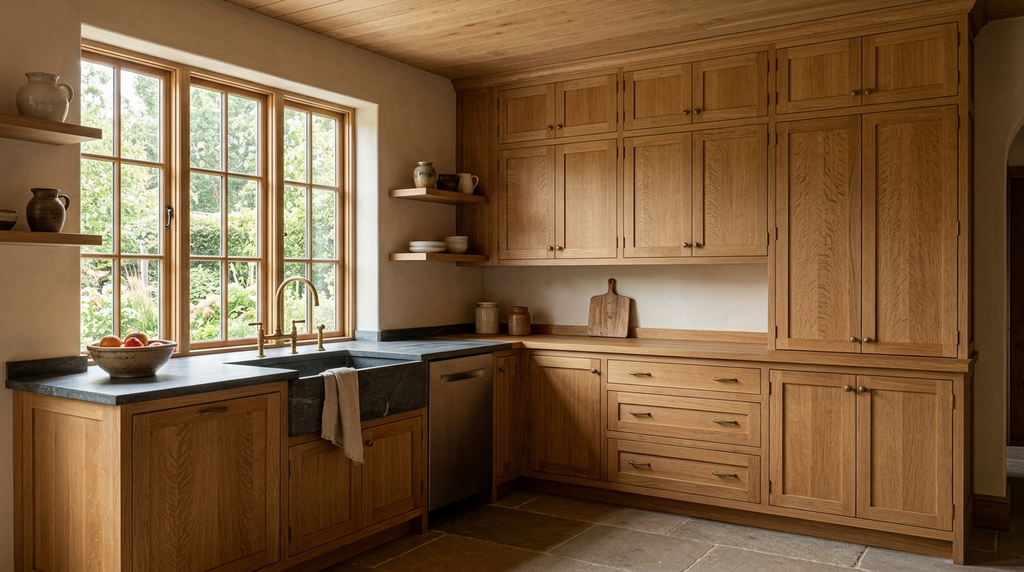
What makes Amish cabinets different is how they’re built, not what they’re called. A good Amish shop builds each order after you approve the design, to your room’s measurements, in solid hardwood you can name. Mass-produced cabinets are built in fixed sizes, in volume, often with particleboard or MDF boxes, before anyone knows your kitchen exists.
That’s the short answer, and it comes with a catch. “Amish” tells you who built the cabinets. It doesn’t tell you how. Two Amish shops can build very differently, and the word on a website proves nothing by itself. So the useful question isn’t whether a cabinet is Amish. It’s what’s inside it, and whether the maker will tell you.
Key Takeaways
- Amish cabinets are made to order from real hardwood to fit your exact measurements.
- The label alone does not guarantee quality, so check the materials, hardware, and finish.
- Custom cabinets cost more and take longer to build, making them best for long-term homes.
What Makes Amish Cabinets Different From Mass-Produced Cabinets?
Four things set them apart: when they’re built, what size they’re built to, what they’re built from, and who does the fitting. Here’s how that lines up against the cabinets you’ll find at a big-box store.
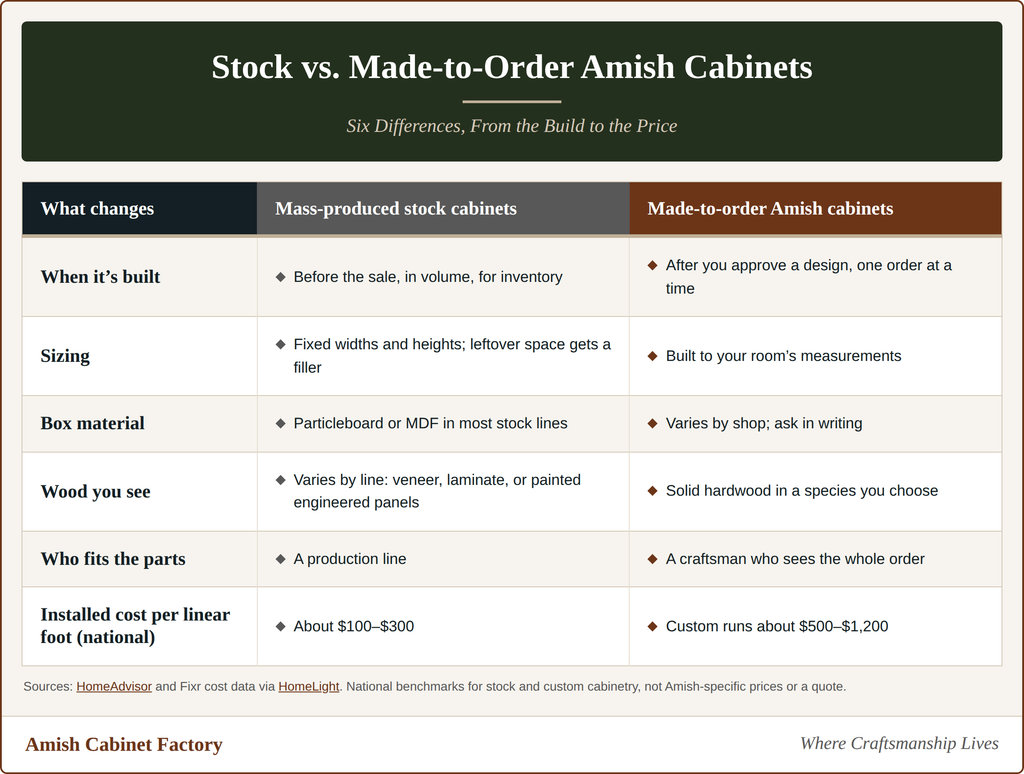
None of this makes stock cabinets bad. They’re built for speed and price, and they deliver both. The sections below explain what you get from the other approach, and what it costs you in money and time.
They’re Built After You Order, Not Before
A stock cabinet exists before you do. It was built to a catalog size, boxed, and stored until someone bought it.
Ours start as a conversation. You share your measurements, floor plan, and ideas. We send back a custom design and a quote, and we go over the layout, style, wood, finish, and storage with you. Nothing gets built until you approve it. Then the cabinetry is handcrafted to order, finished, and inspected before it ships.
That order matters more than it sounds. When a cabinet is built for one kitchen, the person building it knows where it’s going. The sink base gets planned around your plumbing. The cabinet beside the range gets sized for your range, not the average one.
They’re Built to Your Room’s Measurements
Stock cabinets come in set widths, usually in three-inch steps. Rooms don’t. The space left over gets a filler strip, and a kitchen with three or four of them starts to look assembled rather than built.
Made-to-order works the other way around. The cabinet fits the room. Think of the window that sits a few inches off-center over the sink, or a ceiling a little taller than standard. In a stock kitchen, the uppers stop at a catalog height, and the gap above gets covered with crown molding or a soffit. Built to the room, the cabinets can be sized to that window and that ceiling.
Fit also matters once the cabinets reach the wall. Walls are rarely flat or plumb, and your installer will scribe the edges to close the gaps. Cabinets built to accurate measurements give the installer less to fight.
They’re Built in Solid Hardwood You Can Name
A mass-produced door might be a thin veneer over a composite core, or a painted panel with no wood grain at all. Ask a seller what species it is, and you may get a color name instead.
We build in six hardwoods: Brown Maple, Oak, Cherry, Hickory, Walnut, and Quarter Sawn White Oak. Each one behaves differently.
- Brown Maple has a tight grain that takes paint smoothly.
- Hickory is the hardest of the six and shows a bold swing from cream to brown within a single board.
- Cherry darkens as it meets light over its first few years.
Solid wood also moves. It swells and shrinks as humidity changes, across the grain far more than along it. A cabinetmaker who works in solid wood builds for that. Door panels, for example, are left free to move inside their frames so they don’t crack in a dry winter. That’s knowledge you only need when you build in real wood.
One honest note: solid hardwood is what you see and touch. Many well-built cabinet boxes use plywood, which is stable and strong. Ask any maker which parts are solid wood and which aren’t.
Handcrafted Doesn’t Mean No Power Tools
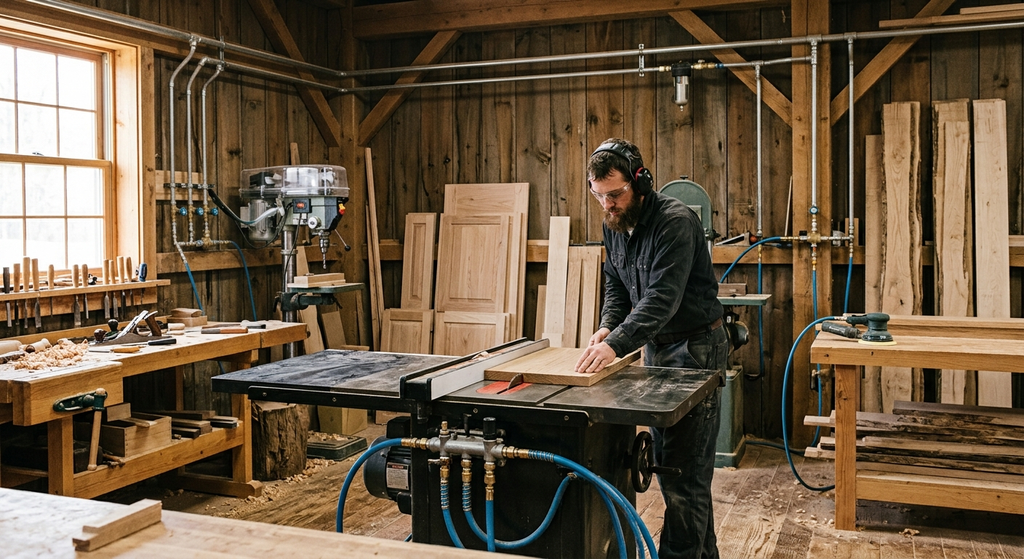
This surprises people. Many Amish shops run table saws, drills, and sanders, powered by compressed air or hydraulics instead of the public power grid. What a shop may use varies from one church community to the next.
So “handcrafted” doesn’t mean every cut is made with a hand saw. It means a person, not a production line, decides how each part fits. Someone checks that the face frame is square. Someone fits each door so the gap around it runs even. Someone sands between coats of finish and runs a hand over the surface to feel what the eye misses.
A fair question for any maker is which steps are done by hand and which by machine. A shop that’s proud of its work will walk you through it.
What’s Inside the Box Matters More Than the Name
Doors get the attention in a showroom photo. The box does the work. The sides, back, and shelves carry your countertop, your dishes, and the weight of a loaded drawer opened many times a day. The sink base is where a weak box shows its age first: a slow drip, a swollen bottom panel, a door that won’t close.
Here’s what we’d check on any cabinet, ours included:
- The box. What material, how thick, and how the corners are joined.
- The drawers. Pull one out and push on the sides. A well-made drawer runs straight and doesn’t rack side to side.
- The hardware. Hinges and slides are graded under ANSI/BHMA A156.9. Ask what grade yours are. A good maker will know.
- The finish. Ask what product goes on and how many coats. A good finish is what lets a kitchen wipe clean for years.
For a yardstick, the Kitchen Cabinet Manufacturers Association certifies cabinets that pass 14 tests, including opening and closing doors and drawers 25,000 times under load. You don’t need a certified cabinet. But you can ask a maker how theirs would hold up to that kind of use, and how they know.
What Amish Cabinets Don’t Do Differently
Some things stay the same, or work against you, and you should know them before you compare.
They cost more than stock. Building one kitchen at a time takes more hours than building thousands of identical boxes. National data puts custom cabinets at roughly $500 to $1,200 per linear foot installed, against $100 to $300 for stock. Our full kitchens usually come in between $15,000 and $30,000 for the cabinetry.
They take longer. Made-to-order means nothing is waiting on a shelf. If you need cabinets in a few weeks, made-to-order isn’t the right path.
We don’t install. We build your cabinets to order and coordinate delivery, so they arrive ready for your contractor or an installer you choose. When you compare our quote to one that includes installation, add your installer’s cost to ours first.
They don’t fix a bad layout. A well-built cabinet in the wrong spot is still in the wrong spot. The design step is where the real difference gets made, so take your time with it.
Are Amish Cabinets Worth It?
It depends on your room and how long you’ll stay. If your kitchen has walls that catalog sizes don’t fit, if you want a particular hardwood, or if you plan to cook in this kitchen for the next twenty years, made-to-order cabinetry earns its price. You’re paying for a kitchen that fits, in a wood you chose, built by someone who saw the whole order.
If your room is a standard rectangle and you’ll sell in three years, stock or semi-custom may serve you just as well. We’d rather tell you that now than sell you something you don’t need.
Either way, judge cabinets on what you can verify: the wood, the box, the drawers, the hardware, and the finish. If you want to see what that looks like in a finished room, see our custom kitchen cabinets.
Conclusion
What makes Amish cabinets different is the way they’re built: after you order, to your room’s measurements, in solid hardwood you can name, by people who fit each part by hand. The label alone guarantees none of that. The box, the drawers, the hardware, and the finish are where the difference shows up, and any maker should be able to tell you about each one.
So ask. Ask who builds the cabinets, what the box is made of, and how the drawers are joined. Then compare.
When you’re ready to see what that looks like for your room, request a free design consultation. Share your measurements and ideas, and we’ll send back a custom design and quote in the hardwood you choose.
Frequently Asked Questions
Are Amish cabinets better than other cabinets?
Not automatically. Amish cabinets are made to order and built by hand, which gives them an edge in fit and in the wood you can choose. Build quality still depends on the shop. Ask about the box, drawers, hardware, and finish before you decide.
Are Amish cabinets solid wood?
In a solid wood cabinet, the doors, frames, and drawer fronts are the parts you see and touch. Boxes vary by shop, and plywood is a sound choice for them. Ask which parts are solid wood. We build in six hardwoods: Brown Maple, Oak, Cherry, Hickory, Walnut, and Quarter Sawn White Oak.
Do Amish craftsmen use power tools?
Many do. Many Amish shops run saws, drills, and sanders powered by compressed air or hydraulics instead of grid electricity, and the rules vary by community. “Handcrafted” refers to who fits and finishes the cabinets, not to whether a power tool touched them.
Do Amish cabinets cost more than stock cabinets?
Yes. Custom cabinetry runs about $500 to $1,200 per linear foot installed nationally, against roughly $100 to $300 for stock. Our full kitchens typically cost $15,000 to $30,000 in cabinetry.
How long do Amish cabinets take to build?
Longer than stock, because nothing is built until you approve the design. If the client won’t publish a range, use: “Timing depends on your design, species, and finish. We’ll give you a schedule with your quote.”
Do Amish cabinet makers install the cabinets?
Some do, and some don’t. We don’t. We deliver your cabinets ready for your contractor or installer, who will level, scribe, and fasten them to your walls.
Can Amish cabinets be painted?
Yes. We offer paint or stain in the color you choose. For a painted kitchen, Brown Maple is the easiest wood to start with, because its tight grain lets paint lay flat.