


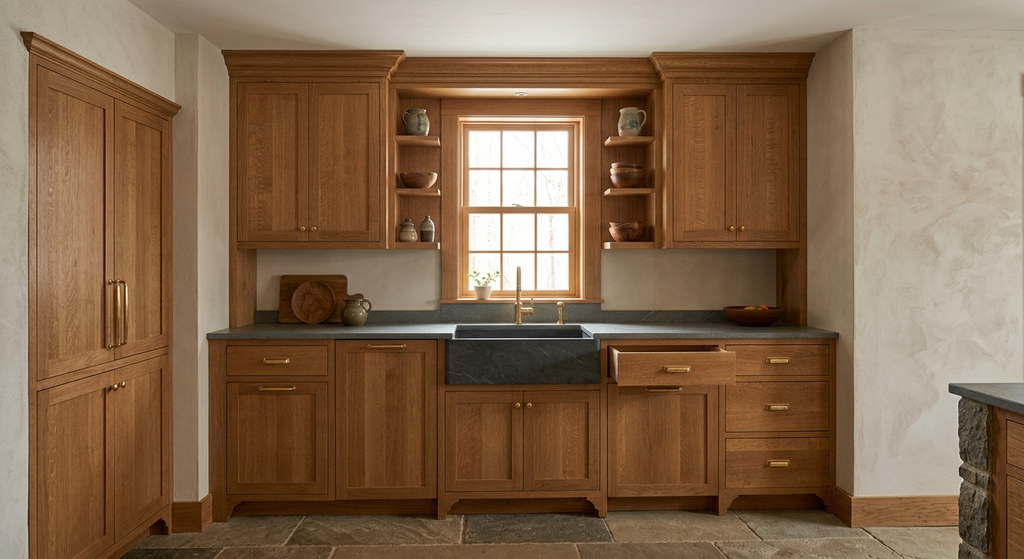
Amish cabinets can be worth it if you plan to stay in your home, your kitchen doesn’t fit catalog sizes, and you want solid hardwood you can name. Custom kitchen cabinets generally cost more than stock cabinets because they are made to order and can be sized and specified for an individual kitchen. Actual prices depend on the materials, construction, finish, kitchen layout, and whether measuring, delivery, and installation are included.
Key Takeaways
- Amish cabinets are worth the investment if you plan to stay in your home long-term, as custom cabinetry rarely recoups its full cost at resale.
- The “Amish” name indicates who built the cabinets rather than construction standards, so you must evaluate the specific box materials, joinery, hardware grade, and finish.
- Comparing custom and stock quotes requires evaluating identical scopes, as custom pricing typically excludes installation and accounts for made-to-order sizing instead of standard filler strips.
What Makes a Cabinet “Amish”?
“Amish-made” generally describes cabinetry produced by Amish craftsmen or an Amish-operated workshop. It is not, by itself, a standardized cabinet-quality grade. Buyers should verify who manufactures the cabinets, where they are made, and which construction specifications apply to their order.
It also doesn’t mean hand tools only. Many Amish shops run full-size saws, planers, and sanders on air or hydraulic power from a diesel engine instead of grid electricity. What sets good work apart isn’t the absence of machines. It’s the hand work around them: fitting, sanding, and finishing done by people who learned the trade at a bench. Ours are handcrafted to order by Amish craftsmen.
So when a seller tells you their cabinets are Amish-made, take it as a starting point. Then ask who builds them, where, and how. We’ve just answered all three for ours, and any maker you’re considering should be able to do the same.
What Are You Paying For With Amish Cabinets?
You’re paying for five things: the wood, the box, the fit, the finish, and the hardware. Each one can be done quickly or done well, and each one is something you can check.
The wood
We build in six solid hardwoods: Brown Maple, Oak, Cherry, Hickory, Walnut, and Quarter Sawn White Oak. Wood species affect grain, color, hardness, and how the finished surface looks. Cherry generally deepens in color with light exposure. Hickory is a hard, strongly grained option, while maple is often selected for painted cabinetry because of its relatively subtle grain. The final result also depends on panel construction, surface preparation, and the finish system. You can explore available wood species and pick the one that suits how you live.
The box
This is where a lot of the price gap between cabinet types lives. Most stock lines use MDF or particleboard boxes. Particleboard does its job when it stays dry, but the cabinet under your sink sees steam, wet sponges, and the occasional slow drip. A 1973 study of ten commercial particleboards found that repeated humidity cycles caused 5.5% to 15% thickness swelling, with roughly one-third to one-half remaining after humidity returned to its original level. Although the study predates modern cabinet materials, it illustrates why moisture protection matters, especially around sink bases.
The fit
A made-to-order cabinet is built after the design is approved, to one room’s measurements. A window that sits off-center over the sink, a wall that runs out of plumb, a ceiling taller than the catalog assumed: stock cabinets fill those spots with filler strips. Ours fill them with cabinets. That’s labor a factory spreads across thousands of identical boxes. You pay for it, and in return, the cabinet run fits the wall it’s fastened to.
The finish
A good finish is what lets a kitchen wipe clean for decades instead of looking tired in five years. Paint shows wear on the edges first. Stain lets the grain show and hides small dings. Ask what product goes on and how many coats.
The hardware
Hinges and drawer slides do more work than any other part of a cabinet. Think about the silverware drawer, opened before every meal and again at every cleanup. ANSI/BHMA A156.9 establishes performance requirements and testing for cabinet hardware, including drawer slides. Ask the manufacturer for the slide brand and model, its applicable performance rating, and the manufacturer’s test or specification documentation.
Here’s a fear worth naming: paying $20,000 and getting something that looks like the $9,000 kitchen. On delivery day, from across the room, the two can look close. The difference shows up later, in the sink base, the busiest drawer, and the door edges. That’s why these five questions matter more than the word on the brochure.
How Much Do Amish Cabinets Cost?
Amish cabinets sit in the custom range. Here’s how the three types compare on national cost data:
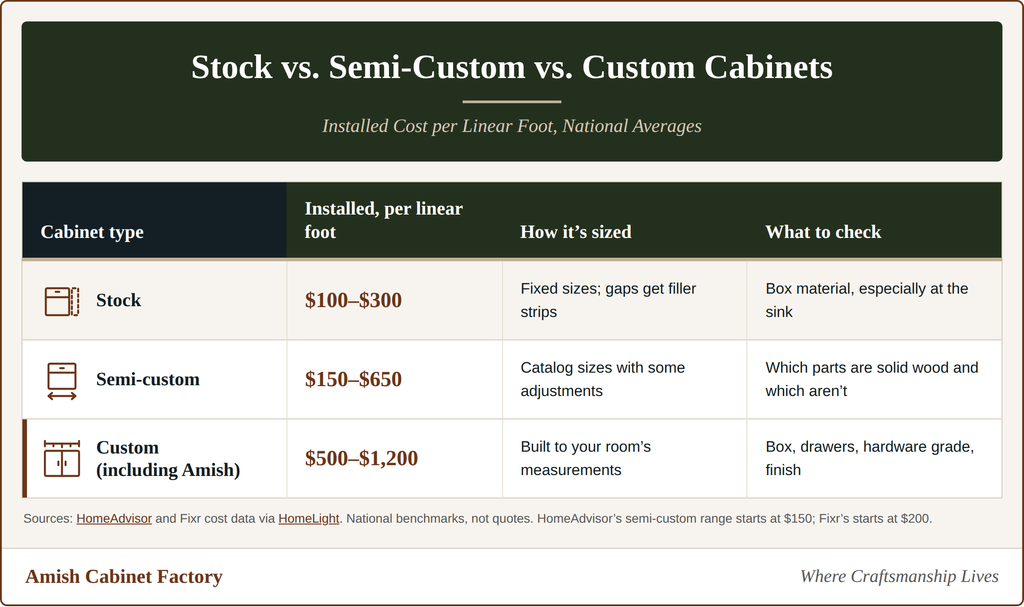
Prices that individual Amish shops publish land inside that custom range. One Pennsylvania Amish shop lists fully custom kitchens at $550 to $1,200 per linear foot installed. That’s one business, not an average.
Here’s ours. A typical full kitchen costs $15,000 to $30,000 in cabinetry. We don’t install, so add your installer’s cost before you compare our quote to an installed one.
How Long Do Amish Cabinets Last?
Well-built kitchen cabinets can last a very long time. In a 2007 National Association of Home Builders study of housing components, kitchen cabinets were expected to last up to 50 years. Treat this as a broad industry estimate, not a warranty or a prediction for any particular cabinet. Materials, construction, installation, moisture exposure, maintenance, and changing design preferences all affect how long cabinets remain serviceable.
The more useful point is that cabinets rarely fail all at once. They wear in a few predictable places. The sink base takes slow leaks. Drawer slides sag, and drawers start to rack side to side. Painted edges chip where hands and hips meet them. Doors drift out of line as hinges loosen. Each of those comes back to the box, the hardware, and the finish.
A lot of cabinets also get replaced while they still work, because the owner tired of the look. That’s an argument for choosing a door style and wood you’ll still like in fifteen years, not just the one trending this spring.
Do Amish Cabinets Add Resale Value?
Some, but probably not all of what you spend. If resale is your main reason for buying, it’s worth knowing that up front.
The 2025 Cost vs Value Report tracks how much of a remodel’s cost comes back when the house sells. Nationally, a midrange major kitchen remodel recouped about 51% of its cost. An upscale major kitchen remodel recouped about 36%. These figures cover complete remodeling projects, not cabinetry alone, and actual results vary by market and project scope.
So the value of Amish cabinets is mostly the value of living with them. Here’s one way to think about it. Before any resale value, a $20,000 cabinetry order you cook in for twenty-five years costs $800 a year. If you sell in four years, it costs $5,000 a year, less whatever the sale gives back. Same cabinets. Very different deal.
If you’re on the fence, be honest about how long you’ll stay. That one answer settles more of this decision than any spec sheet.
When Are Amish Cabinets Worth It, and When Aren’t They?
They’re worth it when the kitchen is a long-term decision, and the room or the material matters to you. They aren’t when speed, a standard room, or a short stay come first.
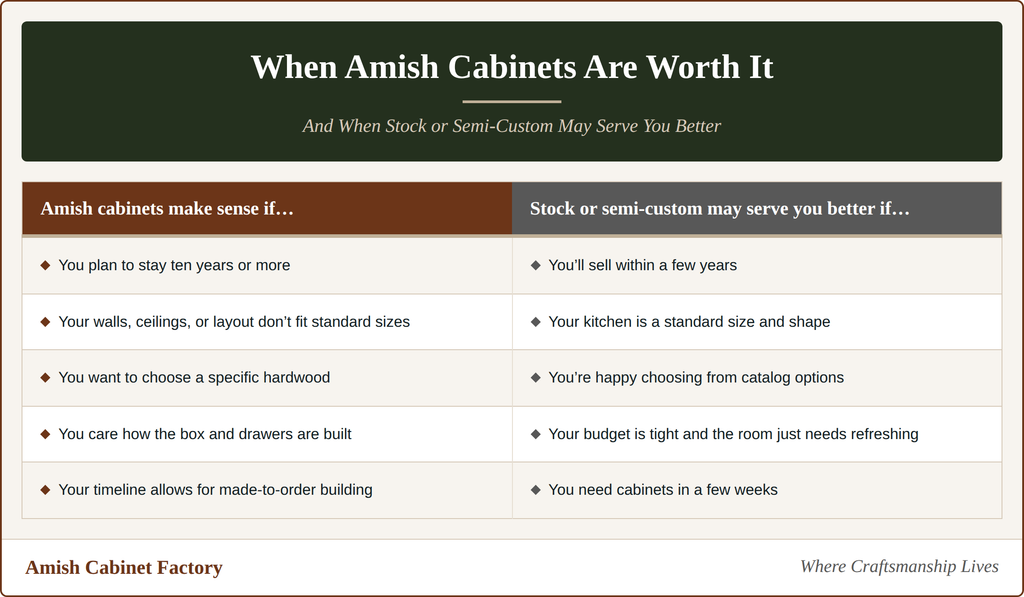
A standard room in a house you’ll leave in three years doesn’t need custom cabinetry, and we’ll say so if that’s your kitchen.
Amish cabinets also come with trade-offs of their own, and they’re worth weighing before you choose a maker:
- Quality varies from shop to shop. The word covers a wide range of work. That’s why the questions below matter more than the label.
- You may never talk to the builder. A lot of Amish cabinetry is sold through dealers. Ask how your questions reach the shop, and who answers them.
- Distance matters. Cabinets built in one region and delivered to another depend on careful crating and freight.
- Solid wood moves. Panels expand and shrink a little with the seasons. On a painted door, you may see a fine line where the panel meets the frame in dry winter months. It’s normal, and it means the panel can move instead of crack.
The other comparison worth making is a local custom cabinetmaker. A local shop can measure your room, install the cabinets, and come back to adjust a door. Some include all of that in their price, which can make their quote look higher than it is next to ours. We build from the measurements you share, and your installer handles the final fitting. If you want one company responsible from measuring to the last hinge adjustment, a local shop may suit you better. If you already have a contractor, made-to-order cabinets that arrive ready for installation fit right into the work they’re doing.
How Do You Know You’re Getting Your Money’s Worth?
Ask every maker the same questions, get the answers in writing, and compare them side by side. Here’s the list we’d use, with our own answers:
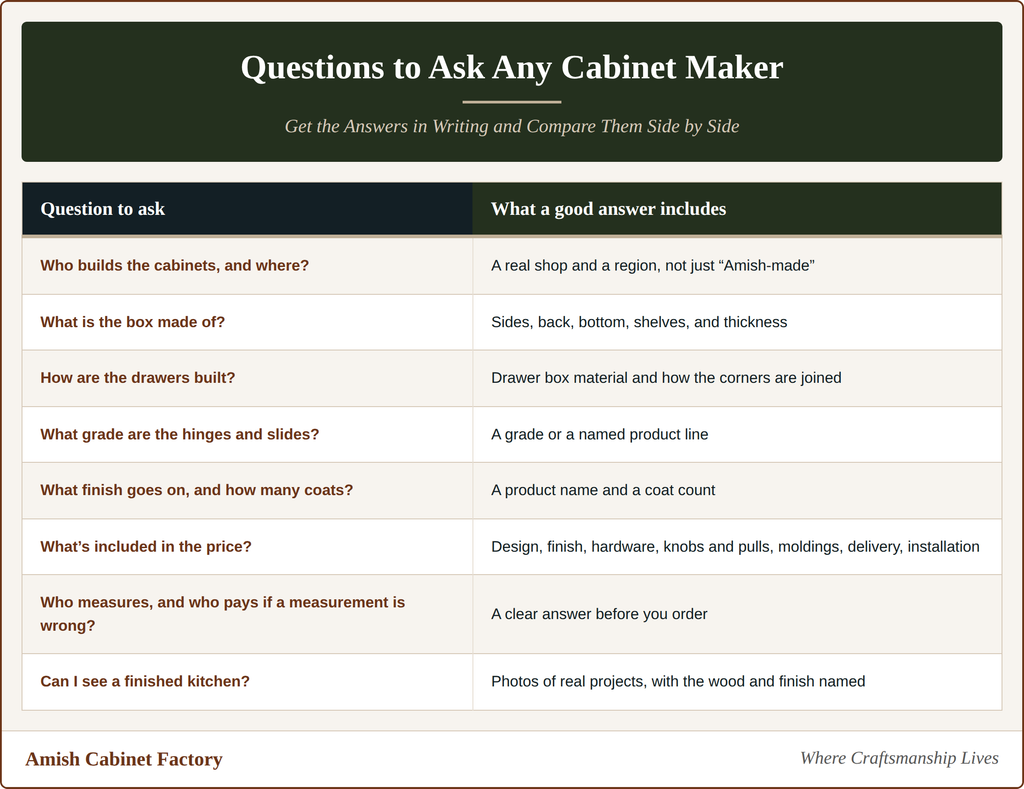
Then open a few drawers in a finished kitchen if you can. Well-made drawers run straight, close quietly, and don’t rack side to side when you push on one corner. It’s the quickest test there is, and it tells you more than a brochure will.
Conclusion
Amish cabinets are worth it when you’ll live with them for years, when your room doesn’t fit standard sizes, and when you want to choose the hardwood. A kitchen rarely pays that back at resale, so the value is in the years of use.
The word “Amish” is a starting point, not a guarantee. The box, the drawers, the hardware, and the finish decide how a kitchen holds up. Ask about all four, and compare quotes on the same specifications. You can see how ours are built in our custom kitchen cabinets.
Frequently Asked Questions
Are Amish cabinets worth the extra cost?
They can be if you value custom sizing, material choices, and long-term use. Stock or semi-custom cabinets may be better for standard layouts or shorter stays.
Are Amish cabinets solid wood?
It depends on the maker. Our doors, face frames, and drawer fronts use solid hardwood. Ask what materials are used for the cabinet boxes and other components.
Are Amish cabinets better than stock cabinets?
Not automatically. Compare materials, construction, hardware, customization, and price to determine which offers the best value for your needs.
Are Amish cabinets more expensive than a local custom cabinetmaker’s?
Not always. Many local shops include measuring and installation in their price, and we don’t, so compare the same scope. Add your installer’s cost to our quote, then compare the box, drawers, hardware, and finish line by line.
Are Amish cabinets made by hand?
They’re built by hand with the help of machines. Many Amish shops run powered saws, planers, and sanders on air or hydraulic systems instead of grid electricity. The handwork comes in the fitting, joinery, sanding, and finishing.
Do Amish cabinets come installed?
It depends on the seller. Ours don’t. We build your cabinets to order and deliver them ready for your contractor or an installer you choose.
How long do Amish cabinets take to make?
Lead times vary by maker, design, and workload. We provide a production schedule with your approved design and quote.