


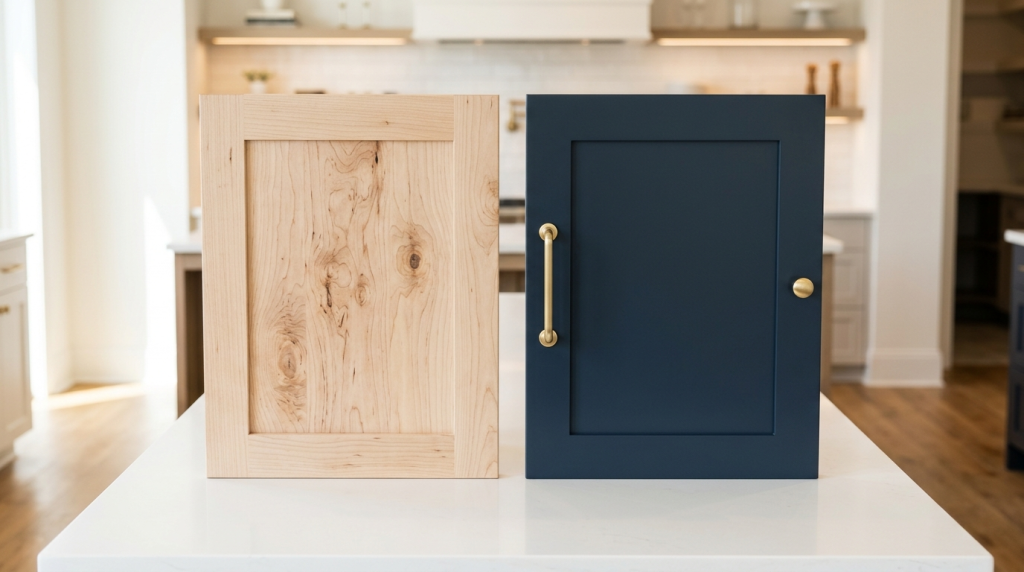
Prefinished cabinets are generally the better choice for most homeowners remodeling a lived-in kitchen, as they come factory-finished, fully cured, and ready for immediate installation. While unfinished cabinets have a lower initial purchase price, they require on-site painting or staining, which typically costs an additional $1,400 to $6,500 and extends the disruption to your home.
The unfinished vs finished cabinets question isn’t really about the wood. It’s about who puts the finish on, where they do it, and how many surfaces they reach. A finish is the part of a cabinet your hands touch every day. It’s worth knowing who’s responsible for it.
Key Takeaways
- Unfinished is cheaper to buy, not always cheaper to own. Most of what you’d pay a painter is labor, so you either spend the money or spend the weekends.
- Where the finish goes on matters as much as what it is. A finish only protects the surfaces it covers, and a shop can reach surfaces that are hard to reach once cabinets are installed.
- Unfinished fits a few specific jobs. Matching existing woodwork, an experienced finisher with the space to work, or a builder whose painter is finishing the whole house.
What’s the Difference Between Unfinished and Prefinished Cabinets?
An unfinished cabinet is fully built but bare. The wood is sanded and ready, with no stain, paint, sealer, or topcoat. A prefinished cabinet has its finish applied by the maker before it leaves the shop.
The cabinet underneath can be the same. The difference is everything that happens after the last joint is glued: sanding between coats, sealing, color, topcoat, and the drying and curing time in between. With unfinished cabinets, that work moves to your garage or your kitchen, and onto your schedule.
Walk into a home center and the unfinished aisle is stock cabinetry. Home centers carry unfinished cabinets usually oak or maple, in fixed sizes. Some custom cabinetmakers will build unfinished cabinets to your measurements. Others build only finished work, so ask.
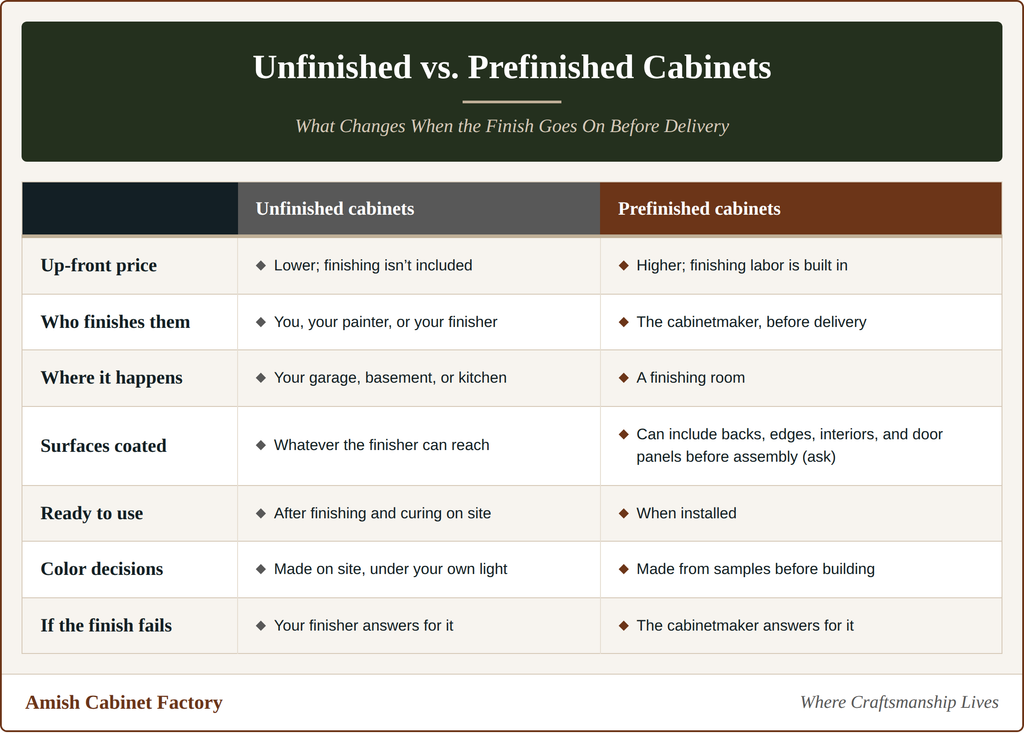
Here’s how the two compare side by side:
Are Unfinished Cabinets Cheaper?
At the register, yes. You aren’t paying for the finishing labor. But finishing is a real job, and the cost doesn’t go away. It moves.
National data gives a wide range for what a painter charges. Fixr’s 2026 figures put painting a kitchen’s cabinets at $2,500 to $6,500, with $4,000 as the average. Thumbtack’s data comes in lower, with most jobs between $1,390 and $3,353. Kitchen size, door count, and local labor rates all push a quote up or down.
Two things about those numbers are worth knowing. First, labor makes up about 85% of a professional cabinet paint job, according to Fixr. The paint is cheap, but the hours aren’t. So if you finish unfinished cabinets yourself, you’re trading that labor for your own time.
Second, those figures are for repainting cabinets that are already installed. New, bare wood skips the stripping. But every surface still has to be sanded, sealed, and coated, including the backs, edges, and interiors a repaint doesn’t touch. Use the ranges as a planning number, then get a written quote for your actual cabinets.
There are costs that don’t show up on a quote, too. A kitchen being finished on site is a kitchen you can’t cook in. Fixr estimates four to five days for a pro to prep and paint an average kitchen, and that’s before the finish has fully cured. If a door runs or a coat goes on too heavy, fixing it costs more time.
Which Holds Up Better: Unfinished or Finished Cabinets?
Prefinished cabinets have the edge. A finish only protects the surfaces it covers, and it’s far easier to cover all of them before the cabinets are fastened to your wall.
How well a finish protects wood depends on the finish itself, how much goes on, and how it’s applied. A finishing room controls all three. A kitchen finished on site, around countertops and appliances, controls fewer of them. These are the spots where the difference shows first:
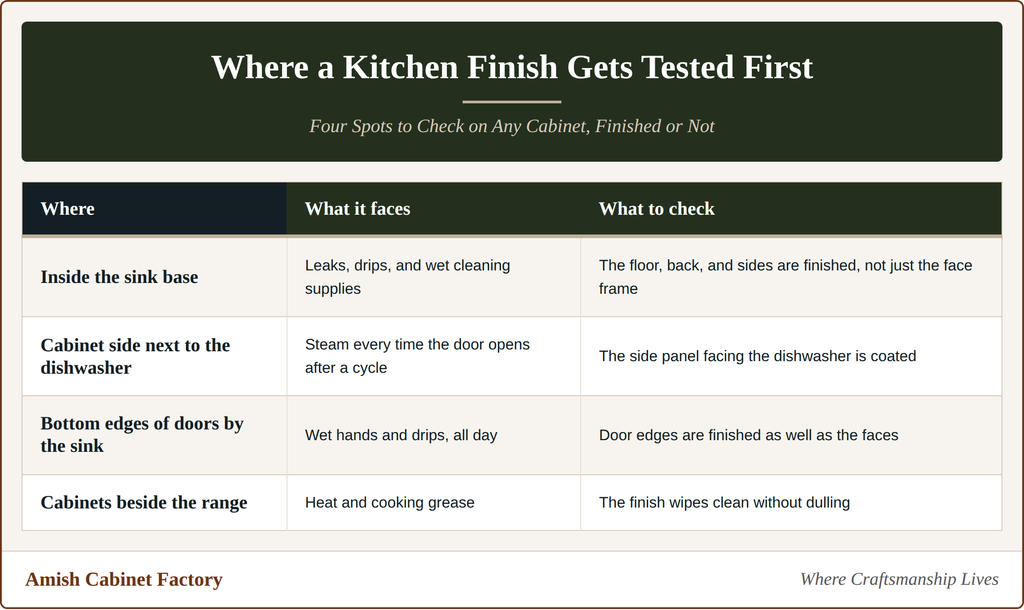
Two more details are easy to miss. On a frame-and-panel door, the center panel shrinks a little in dry winter air. If it was finished after the door was assembled, a thin line of bare wood can show at its edge. And a finish keeps hardening after it feels dry. USDA testing found it can take weeks to months to reach full moisture resistance. In a shop, cabinets can wait. In your kitchen, you’re cooking on them.
When Do Unfinished Cabinets Make Sense?
Unfinished cabinets are a reasonable choice in a few situations. If one of these describes you, they deserve a serious look.
- You’re matching existing woodwork. A stained door casing or an older built-in in the next room can be hard to match from a sample. Finishing on site lets you adjust the color under your own light, next to the wood you’re matching.
- You’re an experienced finisher. You have a spray setup, a clean, ventilated space, racks, and the patience for sanding between coats. You’ve done this before and know what blotching looks like on maple and cherry.
- You’re a builder or remodeler with a painter already on the job. If your painter is finishing every door, casing, and built-in in the house, one finish system and one schedule can make sense.
- It’s a secondary room on a flexible timeline. Cabinetry for a laundry room or mudroom can be finished at your pace without taking the kitchen out of service.
When Are Prefinished Cabinets the Better Choice?
For a remodel in a home you’re living in, prefinished cabinets are the steadier path. They suit you if:
- You need the kitchen back. Delivery to daily use is a matter of installation, not installation plus a finishing project.
- You want every surface protected. Interiors, backs, edges, and door panels can all be finished before the cabinets ever see your walls.
- You’ve chosen a wood that’s tricky to stain. Cherry and maple can blotch under pigment stain without the right prep. A finisher who does it daily knows how each species takes color.
- You want one party responsible. If the finish fails, there’s no debate over whether the cabinet or the painter is at fault.
How Does Finishing Fit Into Your Remodel Schedule?
Prefinished cabinets keep the schedule simple. They’re delivered, your installer fastens and levels them, and your countertop fabricator templates the tops once the base cabinets are set. Unfinished cabinets add a step, and you have to decide where it goes.
Finish before installation
This gives the best access to every surface. It also takes space. A medium kitchen has 30 to 45 doors and drawers, and each one needs both faces and all four edges coated, with drying time on a rack between coats. The boxes need the same care. A two-car garage fills up fast.
Finish after installation
This saves floor space but costs coverage. The finisher has to mask the walls, the floor, and anything already in place. If the countertop is in, they’re working around stone. If it isn’t, the fabricator waits. The backs of the cabinets and the sides against the wall won’t get coated at all once they’re fastened.
Either way, the kitchen is a work site for a while. Paints, varnishes, and stains release volatile organic compounds while they’re applied and as they dry, so plan on ventilation and time out of the room. And sequence the other trades around it. An electrician installing under-cabinet lighting will want the wall cabinets finished first, not after the fixtures are mounted.
One step stays the same for both. Your installer will scribe filler strips and end panels to walls that aren’t straight, and every fresh cut leaves bare wood. Ask your cabinetmaker for touch-up material matched to your finish.
How We Finish Our Cabinets
Every cabinet we build is finished and inspected before it leaves for delivery, then arrives ready for your contractor or installer. You can see how our made-to-order process works from first conversation to delivery.
You choose paint or stain, in the color you want, on any of the six hardwoods we build in: Brown Maple, Oak, Cherry, Hickory, Walnut, and Quarter Sawn White Oak. If you’re painting, Brown Maple is the wood we’d point you to. Its tight, closed grain lets paint lay flat.
If you’re weighing finished against unfinished because of budget, tell us early. We’d rather talk through where the cost comes from than have you discover it halfway through a remodel. You can also see our custom kitchen cabinets to get a sense of how different woods and finishes look once installed.
What to Ask Before You Buy Either One
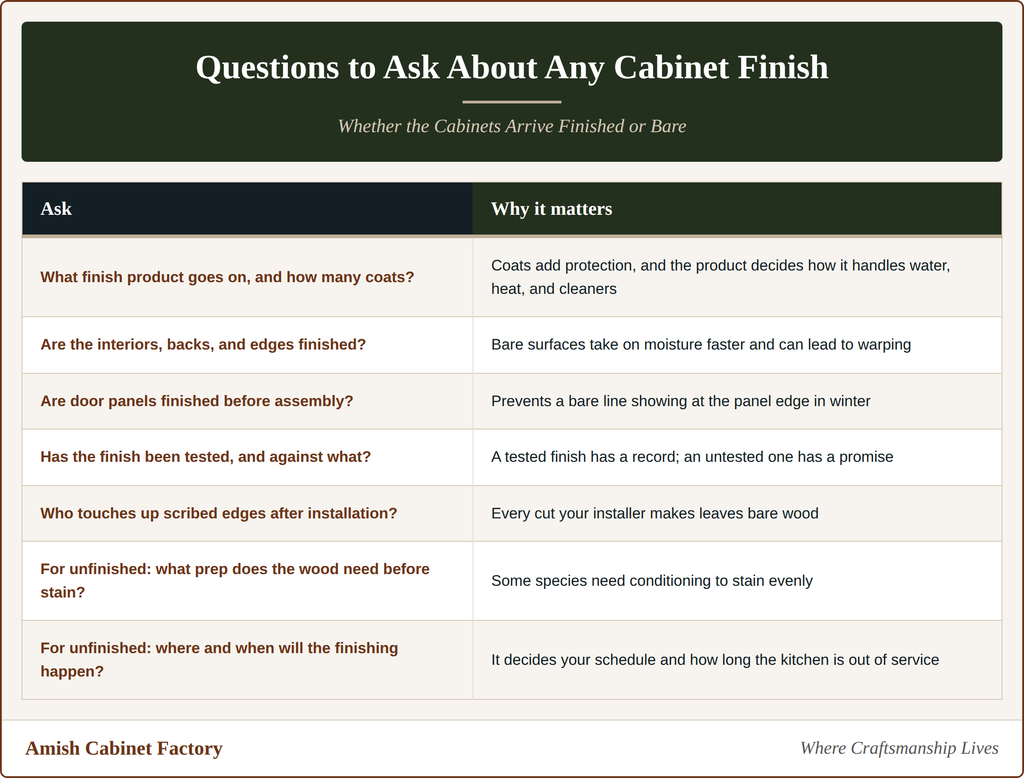
Whichever way you lean, these questions sort out what you’re actually getting:
Conclusion
Unfinished cabinets cost less up front, but finishing them is a real job. A pro charges about $1,400 to $6,500 for a kitchen, and doing it yourself takes days of sanding, coating, and waiting. Prefinished cabinets come with that work done, cured, and with someone accountable for it.
The biggest variables are how many surfaces get finished, how many coats go on, and how long your kitchen can be out of service. If you’re matching existing woodwork or you have an experienced finisher on the job, unfinished can make sense. For a kitchen you live in and cook in every day, prefinished is the steadier choice. Whichever you choose, ask what’s finished, with what, and on which surfaces.
When you’re ready to choose a wood and a finish for your own room, request a free design consultation. Share your measurements and ideas, and we’ll send back a custom design and quote.
Frequently Asked Questions
Is it hard to stain or paint unfinished cabinets?
It’s slow more than hard. Every surface needs sanding, sealing or priming, and at least two coats, with drying time between each one. Stain is less forgiving than paint. Maple and cherry can blotch without the right prep.
Do unfinished cabinets need to be finished on the inside?
They should be. Bare wood takes on and gives off moisture faster than finished wood, and uneven moisture can warp a panel. Interiors, backs, and the inside of the sink base deserve at least a sealer.
Can you install unfinished cabinets and finish them later?
You can, but you’ll lose access to the backs and the sides against the wall. The finisher will also have to work around countertops, appliances, and walls. Finishing before installation gives better coverage if you have the space.
What’s the best wood for unfinished cabinets you plan to paint?
Among the six hardwoods we build in, Brown Maple. Its tight, closed grain takes paint smoothly. Oak’s open grain shows through paint unless it’s filled first.
How long does a cabinet finish take to cure?
Longer than it takes to feel dry. Forest Products Laboratory testing found finishes can take weeks to months to reach full moisture resistance. Ask the finisher how long to wait before heavy cleaning or before setting appliances against fresh coats.